Planning a Family Trip to the Musée d’Orsay With Children
Updated: Sep 5
If you ask a person to name a museum in Paris, undoubtedly some 99 percent of them will reply with "The Louvre." More than a museum, the Louvre is basically a pop culture icon and home to works like the Mona Lisa and Venus de Milo.
But I'm here to tell you about the Louvre's neighbor across the Seine: The Musée d'Orsay is a titan of the art world and a massive draw in its own right.

Let's look at the facts:
More than 3 million visitors make their way through the museum each year, consistently ranking the Musée d'Orsay among the world's 10 most visited.
The collection, which covers 1848–1914 and picks up where the Louvre leaves off, includes more Impressionist and Post-Impressionist works than anywhere else on the planet. These are names we all recognize: Monet, Renoir, Van Gogh, and Cézanne chief among them.
The former Beaux-Arts railway station turned museum is a stunner of a structure, having been built for the 1900 Universal Exhibition.
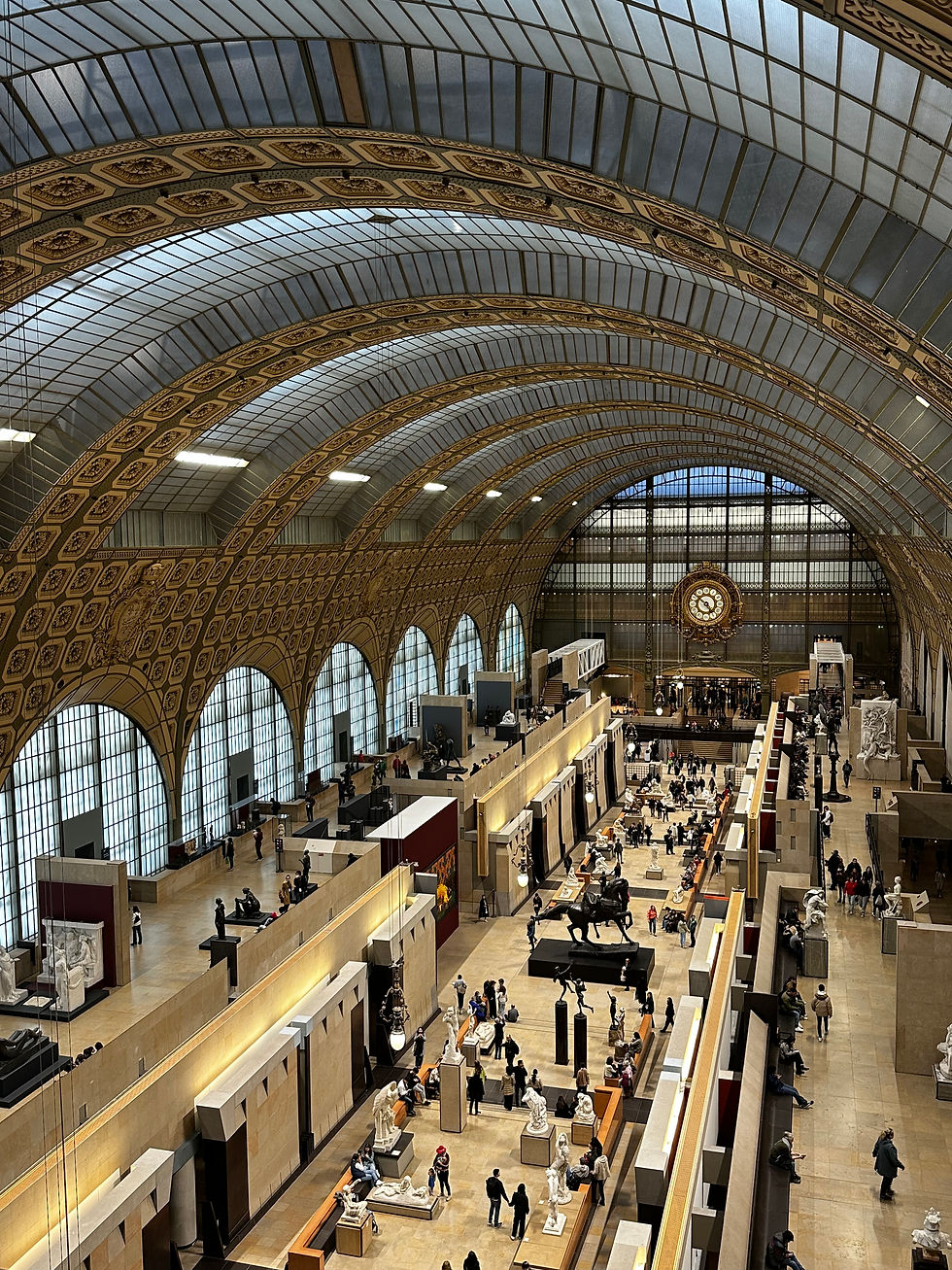
In our eyes, a visit to the Musée d’Orsay can be one of the most rewarding cultural experiences for a family in Paris ... it can also be overwhelming. Packed with masterpieces, monumental sculptures, and fascinating stories, the museum can feel like a lot. That's true of adults and even more so for younger children.
But, with a little preparation, the museum can work surprisingly well for children across different age groups. Here we share hard-won lessons on how to plan the visit, what to spotlight, and what to leave out.
Prepare Before You Go to the Musée d’Orsay
Start by checking the museum's current opening hours and ticket arrangements on the official Musée d'Orsay website. The museum is generally open Tuesday through Sunday, with a late opening on Thursday. It is closed Mondays. Children younger than 18 enter free, while certain young adults also qualify for free admission depending on their residency. Rather than overdo it on a single visit, keep the affordable pricing in mind and consider multiple days spread out across your time in Paris.
Book ahead when appropriate, particularly if you are visiting during a busy period or want to join a family activity. Avoid relying on unofficial "skip-the-line" sellers: The museum specifically warns visitors about fraudulent and mirror ticket websites. Tickets have specific arrival times, and the wait to get in can still be long. Plan ahead and prioritize punctuality.
Before the trip, give children a tiny preview rather than a crash course. Show them two or three paintings they might encounter and ask simple questions: What do you notice? What do you think is happening? Which painting would you want in your bedroom? The goal is to create curiosity, not make them memorize names and dates.
For children aged 6 to 12, the museum's Les Petits M’O website is particularly useful. It introduces works through games, adapted descriptions and podcasts.
Set a Realistic Goal
Let us say this again: Do not plan to conquer the entire Musée d’Orsay in one visit. A family visit of roughly 90 minutes to two hours is often more successful than a determined march through every gallery.
The museum itself offers three family activity booklets—Emotions, 1001 Stories and 1,2,3 Statues!—designed to encourage observation, imagination and creativity. They are an excellent alternative to simply walking from masterpiece to masterpiece. Click the above link to access family resources and download the guides.
Make the Building Part of the Experience
Before focusing on the paintings, let children appreciate the building itself. The museum occupies the former Gare d'Orsay, and its enormous central nave, giant clock and monumental scale provide an immediate and thoroughly authentic "wow" moment.
For a child—definitely for ours—the building can be as interesting as the art. Ask your little ones to imagine what the space was like when it was a railway station. Where would the trains have been? Where would passengers have waited? Why is there such a huge clock?
What to Spotlight for Younger Children
For preschoolers, don't worry about Impressionism. Look for things they can recognize.
Animals are an easy entry point. Ask children to find horses, dogs, cats, birds or other creatures and decide which one they would take home. The museum's children's audio guide is built around three themes—landscape, portrait and animals—and includes 52 points of interest. It is available in English and French for children younger than 12.
Sculptures are another great choice because they are three-dimensional. Walk around them together. Ask: What happens if we look from behind? Does the sculpture look different from the side? How would you pose if you were the model?
Color also works well. Instead of discussing artistic movements, challenge children to find the brightest painting, the bluest painting or a picture containing three different shades of green.
For older children, introduce the idea that artists were experimenting with how people see the world. Impressionist paintings can become a game: stand close to a painting and notice individual brushstrokes, then step back and see how the colors blend together.
Works by artists such as Claude Monet, Édouard Manet, Edgar Degas, Pierre-Auguste Renoir and Vincent van Gogh can provide memorable stopping points—but resist turning each artist into a biography lesson.
Plan for breaks
Museum fatigue is real—for kids and adults. Build in a reset before someone reaches the "I hate museums" stage.
The museum provides practical facilities for families, including elevators and ramps that make the museum accessible with strollers, a baby-changing area, and loaner strollers at the coat check for families whose bulky strollers or carriers cannot be taken through the museum.
What to Avoid
While some of the exhibits are more kid friendly than others, the biggest note we have here is just to avoid trying to do it all. Paris is a phenomenal destination for children, but only when parents are intentional about building a kid-friendly itinerary. A child who remembers three paintings fondly has had a more successful museum visit than one who has been dragged past 100 masterpieces.
Don't force your kids to reflect on each and every piece or to shower you with praise for the site. It's OK for them to enjoy it and for your to love it.
Avoid correcting every observation. If a child says a painting looks messy, ask why. If they think a sculpture looks funny, let them explain. Their observations are the beginning of looking at art.
Avoid spending too long in front of any single work unless the child is genuinely engaged. Five fascinated minutes are better than 15 minutes of enforced attention.
Note: The Musée d'Orsay contains many works depicting the naked human body. Prepare children matter-of-factly: Artists have represented the human body for centuries, and museums display these works because they are part of art history.
Don't Skip the Gift Shop
Museum gift shops are next-level in Paris, and the Musée d'Orsay is no exception. You can see mini versions throughout the museum, but build in time to visit the main shop at the Buffet de la Gare. It features more than 5,000 titles, jewelry, and other trinkets. As you work your way around the museum, there's also a dedicated youth area and souvenir counter.


